
Jumping on the Social Media Bandwagon; Strategic Planning and Alliances Steering Committee Social Media Campaign

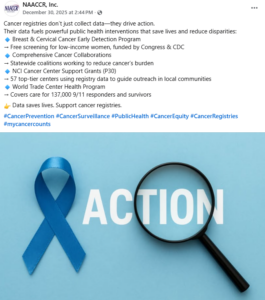
Social media has become a central, if not a primary vehicle for public health communication and campaigns. It helps with reaching a broader audience, promoting health literacy, countering misinformation through posting evidence-based content, and raising awareness about specific health issues, risks, and solutions. Over 80% of U.S. State Departments of Health now have a social media account, and over 80% of cancer patients use social media to connect with their peers.1,2 Simply put, public health communications must adapt to evolving ways to reach a broader audience and to inform our communities with evidence-based information.
For this reason, the NAACCR Strategic Planning and Alliances Steering Committee has embarked on a social media campaign that highlights the essential values of cancer surveillance and cancer registries. In an era of unprecedented U.S. federal and state budget cuts to our public health infrastructure, the promotion and awareness of cancer surveillance as a critical foundation in the fight against cancer is a must if we want to preserve and advance the decades of work invested in building a stronger cancer surveillance system. Just in the most recent post we published, we had over 2,000 unique views. Using our hashtags (#CancerSurveillance, #CancerRegistries) and taglines (support cancer registries, support better outcomes), reposts can quickly go viral. Currently, you can find these posts on LinkedIn and Facebook.
While social media has become an important dissemination source for health promotion and awareness, it is also in the creative ways we tell stories, relay information, and connect the personal with the factual that can make a difference on the budget chopping block, if you will. SPA is exploring these creative outlets, and we are embarking upon a venture in story telling that we hope will make a difference by bringing the patient experience to the foreground and connecting these survivor stories to how and why cancer surveillance matters, because, well, it does. But you already know this.
Stay tuned for these stories and posts in the near future and get ready for reposting and doing your part in our fight to preserve/support cancer surveillance and our fight to save lives.
Sources:
- Jha A, Lin L, Savoia E. The use of social media by state health departments in the US: analyzing health communication through Facebook. J Community Health. 2016 Feb;41(1):174–179. doi: 10.1007/s10900-015-0083-4. [DOI] [PubMed] [Google Scholar]
- Braun LA, Zomorodbakhsch B, Keinki C, Huebner J. Information needs, communication and usage of social media by cancer patients and their relatives. J Cancer Res Clin Oncol. 2019 Jul;145(7):1865–1875. doi: 10.1007/s00432-019-02929-9. doi: 10.1007/s00432-019-02929-9. [DOI] [PMC free article] [PubMed] [Google Scholar]
What to Read Next

NAACCR Education and Training Upcoming Events
NAACCR ODS Exam Prep and Review The NAACCR ODS Exam Prep and Review series is offered prior to each exam…

Standardization and Registry Development Steering Committee: Modular Records Task Force
One of the NAACCR Board strategic initiatives in the Strategic Plan is Innovative Approaches to Data Collection (Minimal Datasets and…

Secondary data sharing: What is it, why is it important, and how is NAACCR involved?
Secondary data sharing (SDS) occurs when a primary researcher shares data with a secondary researcher to advance science. Sometimes the…