

Using Median/Multiple Outlier Testing (MMOT) to Support Central Cancer Registry Operations


Central Cancer Registries continuously strive to improve data quality while ensuring that data are fit for research, surveillance, and cancer control activities. One promising approach is the use of Median/Multiple Outlier Testing (MMOT), a benchmarking method developed by Dr. Huann-Sheng Chen of the National Cancer Institute’s Surveillance Research Program. MMOT helps identify unusual patterns in data completeness by comparing registries, facilities, counties, or other groups against their peers.
This article is based on the presentation, “Data Driven Data Quality: Using Median/Multiple Outlier Testing Method (MMOT) to Strengthen Data Quality and Inclusion Criteria,” which I co-presented with Cassandra Curran (Queen’s University, Canada) during NAACCR’s Epi “Hour” on May 11, 2026. During the session, we discussed the fundamentals of MMOT, how it is currently being used by NAACCR, and practical ways central cancer registries can apply it to support research projects, establish inclusion criteria, and strengthen routine data quality operations.
Originally adopted by NAACCR’s Fitness for Use and Data Assessment (FUDA) Working Group, MMOT is being used to evaluate data items based on the proportion of unknown values and to support data quality assessments. Rather than relying on arbitrary thresholds, MMOT uses statistical methods to identify outliers relative to the overall distribution of data. This approach allows registries to better understand where data quality differs from expected patterns and where additional investigation may be warranted.
Beyond Assessment: Practical Applications for Registries
While MMOT has proven valuable for national data quality evaluations, its usefulness extends well beyond formal assessments. Central cancer registries can apply MMOT in several operational areas.
Supporting Inclusion Criteria for Research
Many registry-based projects require decisions about whether data are complete enough to support a specific analysis. MMOT provides an evidence-based framework for these decisions. Registries can evaluate data items of interest, identify outlier registries or years, and establish project-specific quality benchmarks. This approach allows researchers to make informed decisions about including or excluding specific registries, variables, age groups, or diagnosis years without applying a one-size-fits-all rule.
MMOT also highlights an important consideration: being an outlier does not necessarily mean data quality is unacceptable. A registry may be statistically different from its peers while still maintaining a level of completeness that is appropriate for a particular project. This context helps teams make more refined and transparent inclusion decisions.
Internal Quality Control and Operational Monitoring
MMOT can also serve as a practical quality control tool for day-to-day registry operations. By examining patterns within a registry, staff can identify geographic areas, reporting sources, or time periods that consistently exhibit lower completeness or sudden changes in completeness.
For example, a registry could evaluate completeness by county to determine whether specific regions require additional support, training, or investigation.
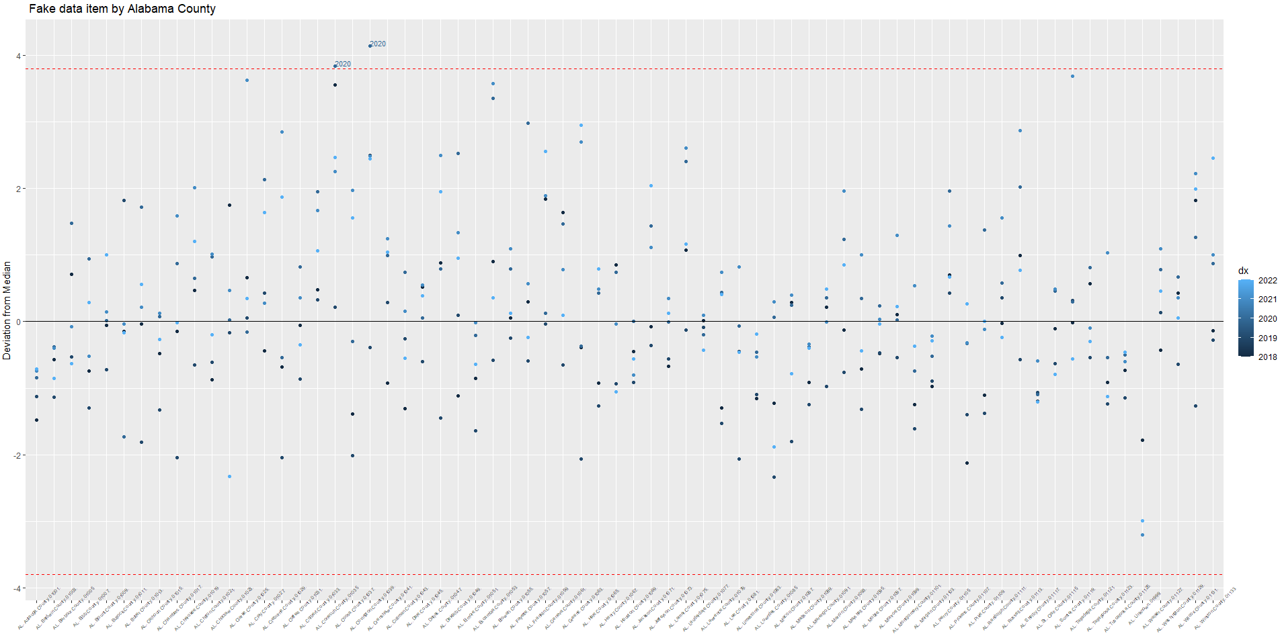
Similarly, MMOT can be applied to reporting facilities to monitor trends over time and identify opportunities for targeted feedback. Instead of broad quality improvement efforts, registries can focus resources on areas where the greatest improvements are likely to occur.
Turning Findings into Action
An important principle of MMOT is that outliers are not necessarily indicators of poor performance. Rather, they provide a starting point for asking important operational questions:
- Is there a coding issue affecting data quality?
- Have reporting practices changed?
- Are there facility-specific or regional challenges?
- Do operational processes need adjustment or additional training?
By identifying where unusual patterns occur, MMOT helps registries direct their limited resources toward investigations that are most likely to improve data quality.
MMOT is more than a statistical method for identifying outliers. It is a flexible tool that can support research planning, quality assurance activities, operational monitoring, and continuous improvement initiatives within central cancer registries. As registries seek innovative ways to assess and strengthen their data, MMOT offers a practical approach for transforming data quality observations into meaningful action. Most importantly, it helps registries focus on understanding and improving their data rather than simply measuring it.
Interested in using MMOT in your registry? If you would like to learn more about MMOT, discuss potential applications, or obtain the code and supporting materials, please contact me here.
Tags: Benchmarking, Completeness, Data Quality, Featured, MMOT
What to Read Next

NAACCR CPR Guidelines to be Incorporated into HL7 LRI Implementation Guide
The NAACCR Cancer Pathology Reporting (CPR) Guidelines – also known as Laboratory Electronic Pathology Reporting Guidelines Volume V – are…

How NAACCR’s Professional Development Steering Committee Advances Training, Mentorship, and Workforce Growth
Strengthening Cancer Registry Professionals: The Work of the NAACCR Professional Development Steering Committee Leadership, Collaboration, and Growth in Cancer Surveillance…

CONCORD*Explorer is now available! Access and Download Global Childhood Cancer Survival Estimates
We are delighted to let you know that CONCORD*Explorer is now live on the NCI website! This is a new…