



National Childhood Cancer Registry Fall Feature
The NCCR Fall Feature highlights how high-quality cancer registry data continue to advance childhood cancer research and data sharing. This edition features a study examining patterns in pediatric cancer genomic testing, the expansion of the Childhood Cancer Data Initiative (CCDI) Participant Index and its integration with the NCCR Data Platform, updates from CCDI symposium and events, and the latest releases of NCCR*Explorer and NCCR data in SEERStat.
Who Gets Tested? New Registry Data Reveals Surprising Patterns in Pediatric Cancer Genomics
NCCR Partner Contribution
A study by Sangaramoorthy, Walia, and Winestone, and colleagues published in JCO Oncology Practice examined who receives genomic testing among children and adolescents with cancer at the University of California, San Francisco (UCSF). UCSF participated in the first NCCR pilots to link electronic health record data with central cancer registry data, creating a richer dataset than either source provides alone. This research highlights how high-quality, population-based cancer registry infrastructure makes it possible to track how institutional changes shape testing uptake over time.
UCSF500, a next-generation sequencing panel designed to include better coverage of genes related to pediatric cancer, became available in mid-2015. The authors report that testing rates rose steadily in the years that followed, climbing from 16.4% of eligible patients in 2016 to 27.5% by 2019. This upward trend tracked closely with two institutional efforts discussed by the investigators, first to provide protocols that aid clinicians in identifying which patients should receive testing. Second, when providers expressed concerns about out-of-pocket costs to patients, UCSF issued test bundling guidance for insurance billing in 2019.
This study was possible because the registry captured consistent, year-by-year data across nearly a decade of cases. Without that longitudinal consistency, it would be impossible to link data from various sources and support local research activities and partnerships between healthcare provider organizations and central cancer registries.
Even as testing expanded institution-wide, it did not expand evenly. Of 758 eligible patients diagnosed between 2016 and 2019, only 34.6% were ultimately tested. Testing was less likely among adolescents (ages 15–19) compared with children under 5, among female patients compared with male patients, among those living in rural areas, and among patients with lymphoma compared with solid tumors. Patients with central nervous system tumors, by contrast, were tested more often. The authors attributed this in part to the growing role of molecular markers in brain tumor classification during this same period.
Notably, the study found no significant differences in testing rates by race, ethnicity, insurance status, or neighborhood socioeconomic status, in contrast to the adult oncology setting where such disparities are well documented. The authors suggest this may reflect UCSF’s approach of folding genomic testing into routine clinical care rather than restricting it to research protocols.
These findings depend entirely on accurate registry data: consistent diagnosis dates, correctly coded tumor types, reliable demographic information, and complete vital status tracking. The authors acknowledge limitations such as the lack of statistical power to detect smaller disparities, reinforcing the need for larger, multi-institutional registry data to validate these findings. Overall, this study shows how population-based cancer registries can work with local researchers to reveal persistent gaps in clinically-relevant genomic testing for young people with cancer by age, sex, rurality, and tumor type.
Foundational Change to Interoperability in Childhood Cancer Research Data
NCCR Partner Contribution
The NCI’s CCDI Data Ecosystem is a network of interconnected tools and resources designed to bring together clinical, research, and registry data related to children, adolescents, and young adults (AYAs) with cancer. As part of this ecosystem, the NCCR Data Platform integrates registry and real-world data from hospitals, research centers, and healthcare administration sources to enhance access to and utilization of childhood cancer and survivorship data. The CCDI was created to establish more efficient ways to share and use childhood cancer data, built on the premise that federating data across sources can produce answers that benefit all children with cancer.
A central challenge to this goal has been data fragmentation. A childhood cancer patient (A) may receive clinical care at a hospital and this information is reported to a central cancer registry. The patient can also be enrolled in a research study under a separate research identifier (Z). Registrars play a critical role in this process: they abstract and code the clinical details of each case, consolidating complex medical records into standardized, structured data that registries use to build de-identified datasets for research. Without this consistent abstraction work happening across hundreds of institutions, there would be no reliable registry record to link to anything else. Registries later help create a de-identified dataset (Z) for research use.
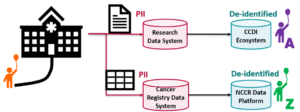
Historically, this has meant that research data and registry-derived data describe the same patient under different identifiers, with no way to confirm it is the same person across datasets. The CCDI has worked with researchers, healthcare institutions, registries, and data resources to solve this through the CCDI Participant Index (CPI), which allows a securely held, publicly shareable identifier to be queried across multiple de-identified datasets to confirm when records belong to the same individual.

The CPI has grown substantially over the past year and can now be queried directly through the NCCR Data Platform. This allows researchers to unite the NCCR’s registry data, medical and pharmacy claims, area-based measures, and radiation oncology information with data held in other resources, including the Children’s Brain Tumor Network (CBTN), St. Jude Cloud, the Treehouse Childhood Cancer Initiative, Kids First, and studies such as the CCDI Molecular Characterization Initiative and Pediatric Molecular Analysis for Therapy Choice (PedMATCH).
A publicly sharable identifier (1) is assigned to the person by the healthcare organization where research and treatment take place. This identifier (1) is shared with both the research program and the cancer registry. Ultimately, the CCDI Participant Index serves as the primary reference point to find data for the same individuals across other data assets (A and Z).
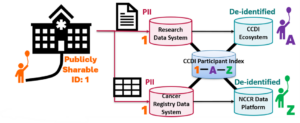
This capability depends on healthcare providers, study coordinators, and registries working together to ensure the accuracy and consistency of their data with registry data serving as the anchor point for many types of linkages. The CPI enables many groups to securely provide identifiers and support a unified view of where the same person is represented in data, even when their information originates from many different institutions and studies over the course of their life.
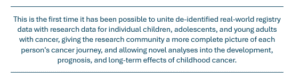
The examples below show the result of a query for all persons in the NCCR that also have data at the CBTN, Kids First, St. Jude Cloud, Treehouse Childhood Cancer Initiative, or in specific studies like the CCDI Molecular Characterization Initiative (phs002790) and PedMATCH (phs002883).
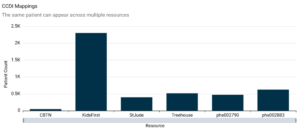
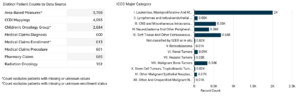
A researcher can see how many patients in these studies have data in the NCCR Data Platform and explore basic descriptive information like cancer diagnosis.
Childhood Cancer Data Initiative (CCDI)’s Symposium at the National Cancer Institute (NCI)
The CCDI’s Office of Data Sharing hosted a symposium on Friday, September 18, 2026, to display progress and to impact childhood cancer research moving forward. The event, at the NCI Shady Grove Campus in Rockville, Maryland, highlighted the foundational work accomplished by CCDI and explored opportunities with members across the cancer research community. Dr. Anthony Letai, NCI Director hosted a welcome event the evening prior to the symposium. Symposium speakers included Dr. Warren Kibbe, NCI Deputy Director for Data Science and Strategy, and Dr. Jack Shern, NCI CCDI Scientific Director.
On November 5-6, 2026, the NCI Office of Data Sharing (ODS) is hosting the Fourth Annual Data Sharing Symposium entitled Data to Discovery: Leveraging Cancer Data in the “Real World,” on the NCI Shady Grove Campus in Rockville, MD.
By ushering in a foundational shift of broad data sharing and collaborative science, CCDI increases the likelihood of rapid advances in cancer research. They will offer scientists, clinicians, policymakers, patients, advocates, and trainees across government, academia and industry an opportunity to learn from one another and explore ways to maximize the benefits of these efforts.
In addition to talks, there will be poster presentations and demonstrations on innovative data sharing. Plan to join for engaging discussions on advancing cancer research through data sharing and reuse. Learn more and register here.
New Release! Updates to NCCR*Explorer and NCCR Data in SEER*Stat!
The NCCR*Explorer and NCCR Data in SEER*Stat were updated on October 7, 2026!
NCCR*Explorer updates:
- The NCCR*Explorer application was updated to include incidence estimates for diagnosis years 2003-2023 and survival estimates for diagnosis years 2003-2022, with follow-up through December 31, 2022. Estimates are based on Surveillance, Epidemiology, and End Results (SEER) and National Program of Cancer Registries (NPCR) registry data submitted to the North American Association of Central Cancer Registries (NAACCR) and included in the Cancer in North America (CiNA) data files.
- The dataset used for this release represents 76% of the U.S. population and includes the following 29 NCCR cancer registries: Arkansas, California (three registries: Greater Bay, Greater California, Los Angeles), Colorado, Connecticut, Florida, Georgia, Hawaii, Idaho, Illinois, Iowa, Kentucky, Louisiana, Massachusetts, Michigan, Minnesota, Missouri, New Jersey, New Mexico, New York, Ohio, Oregon, Pennsylvania, Seattle (Puget Sound), Tennessee, Texas, Utah, and Wisconsin.
- U.S. complete prevalence estimates for persons diagnosed with a childhood (ages <20) cancer were updated to reflect complete prevalence estimates for January 1, 2023. The estimates provided were calculated from SEER Program registries and projected to the entire U.S. using U.S. population estimates. The SEER registries included in the analysis are Atlanta, Connecticut, Greater Bay Area, Hawaii, Iowa, Los Angeles, New Mexico, Rural Georgia, Seattle (Puget Sound) and Utah. For more information on prevalence, please see Cancer Prevalence Statistics Overview.
- The time period for displaying ‘Trends Over Time’ was modified from 2001 to 2003. The start year for the trends was changed to 2003 to allow more registry coverage in the estimates presented.
- Due to the Impact of COVID on SEER Cancer Incidence 2020 data, the 2020 incidence rates are not used in the fit of the Joinpoint trend line(s). Where applicable, the 2020 incidence rates are still displayed on the graphs and data tables.
NCCR Data in SEER*Stat:
- The 2003–2023 NCCR databases are now available in Frequency, Rate, and Survival.
- Additional database details and documentation are provided on the NCCR December 2025 Submission.
NCCR Data Platform Highlights
For more information about the NCCR Data Platform, visit Home – NCCR Data Platform.
Mark your Calendar
November 5-6, 2026 – Data to Discovery: Leveraging Cancer Data in the “Real World” Symposium.
November 2 – December 1, 2026: NCCR Call for Data – BE SURE TO READ THE NEW SUBMISSION INSTRUCTIONS! (NCCR participating registries only). Click here for more information.
What to Read Next

Modeling Reporting Delay for Cancer Registries
Central cancer registries work hard to ensure every new cancer diagnosis is counted so that incidence data can be used…

National Childhood Cancer Registry Summer Feature
The NCCR Summer Feature shares the highlights from the National Childhood Cancer Registry (NCCR) session held at the 2026 NAACCR…

Exploring New Approaches to Data Collection: Modular Records Task Force Final Report
The Modular Records Task Force was initiated in August 2025 to support the NAACCR Board’s Strategic Plan on the strategic…